Lot VII
Coins & Currency
in Delray Beach
Early US, gold, and world coins.
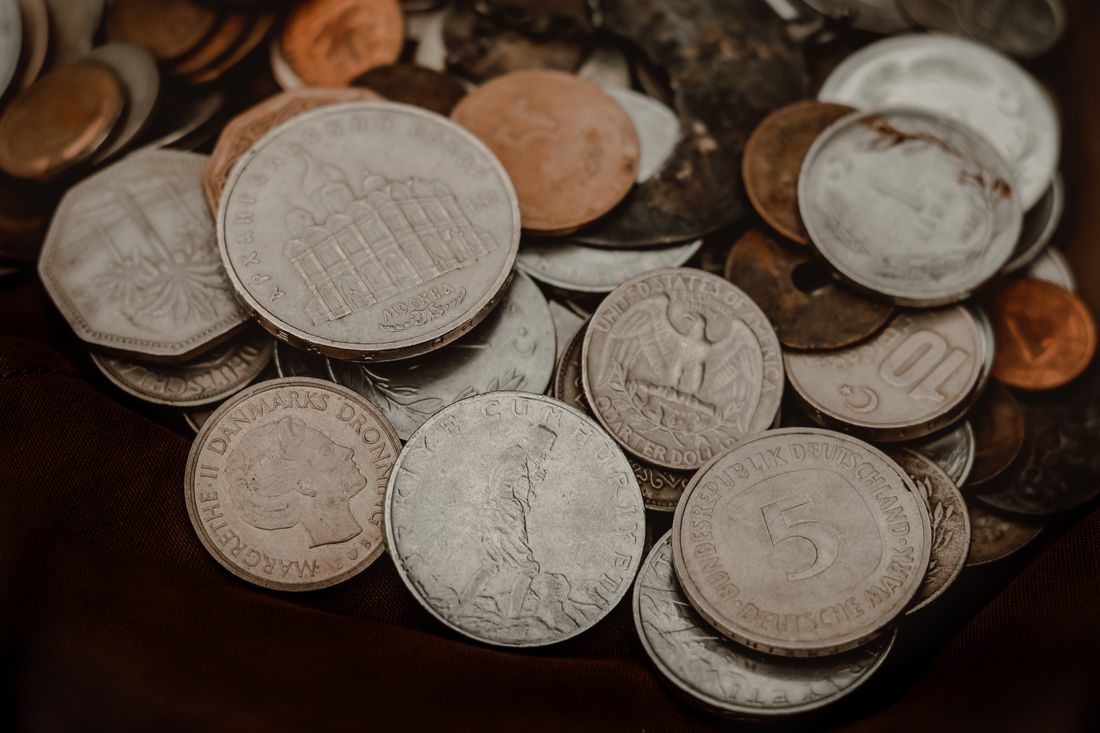
A coin can look the same to a family and to a specialist, and be worth ten times more to one of them. The difference lives in details the size of a grain of rice: a tiny letter under the wreath, a die that was reworked, a surface that has never been touched. Before we name a number, we read the coin the way a numismatist does. Here is that field knowledge, so you can see what we are looking at in your Delray Beach home.
What we look for
- Early US type coins and key dates
- Morgan and Peace silver dollars
- US gold eagles and world gold
- Graded (slabbed) coins and full collections
How we grade coins — the Sheldon scale, dates, mint marks and slabs
Almost every American coin is graded on the Sheldon scale, from 1 to 70. It was proposed by the numismatist William Sheldon in 1949 for large cents and later became the common language of the whole hobby. A 1 is a coin worn so far that it is barely identifiable. A 70 is a theoretical perfect coin, with no visible marks under magnification. The scale breaks into a few working bands:
- 1–11 — Poor to About Good: heavy wear, the design is mostly flattened
- 12–19 — Very Good to Fine: the main design is clear, but fine detail is worn away
- 20–45 — Very Fine to Extremely Fine: sharp detail with light to moderate wear on the high points
- 50–58 — About Uncirculated: only a trace of friction on the highest points
- 60–70 — Mint State: never circulated; the number reflects luster, strike and bag marks
The jump between steps matters more than most owners expect. A “nice, shiny” coin is often an MS-60 or MS-62 with abrasions you can only see under a loupe, while a coin that earns MS-65 or MS-66 is a different market entirely. For many silver dollars the price gap between those two levels is a multiple, not a percentage.
Date and mint mark come before grade. Take the Morgan silver dollar (struck 1878–1904, then once more in 1921) and its successor the Peace dollar (1921–1935). Both are 90% silver and 10% copper and hold about 0.77 troy ounces of pure silver, so every one of them has a melt floor. Above that floor, the small letter on the reverse decides the story. CC means Carson City, whose Morgans were struck in limited numbers and carry a premium. S, O, D and the absence of a letter (Philadelphia) tell us where a coin was made, and scarcity differs wildly from one mint and year to the next. The 1893-S, with a mintage of only 100,000, is the best-known Morgan key date. The 1928 Peace dollar, under 361,000 struck, is the scarce Peace date. A common date such as an 1881-S or an 1884-O in ordinary condition trades close to its silver value.
Third-party grading. The two services collectors trust are PCGS and NGC. They authenticate the coin, assign a Sheldon grade, and seal it in a hard plastic holder, the “slab.” A slab does not make a coin valuable, but it removes doubt for the next buyer, which is why a certified coin in the right grade sells faster and at a tighter spread. We read raw coins ourselves and tell you honestly when certification is worth the fee and when it is not.
The science most buyers (and most dealers) never mention
Behind every coin there is a pair of hand-engraved steel dies, and no two dies are identical. Numismatists have always studied this, because the die tells you how many were struck, in what order, and which varieties are genuinely scarce. The hobby calls these die studies, and the specialist catalogues of Morgan and Peace dollar die varieties (the VAM system) exist because of them. For ancient coins, where one hoard can hold tens of thousands of pieces, the work is brutal: every coin has to be compared with every other.
Machine learning now does the comparing. A 2025 paper on arXiv (Labedan and colleagues) tackled coins from the Juillac hoard, found in 2011 in southwest France: more than 23,200 Roman coins, mostly struck between 294 and 313 AD. The team built a labeled set of 329 coin images split into eight groups of 17 to 81 coins, and scored each pair with a structural-similarity measure (SSIM) borrowed from image analysis. With a clustering step on top, the method found the coins struck from the same die with perfect precision on every group. On the hardest group it scored a ROC AUC of 0.997, against 0.725 for an older shape-alignment method. It also ran in a few hours where the older approach needed more than a day.
A second arXiv study, “Automatic Die Studies for Ancient Numismatics,” went larger. On a set of 2,484 coins from Paphos, its automated pipeline matched the hand-built die groupings far better than the previous automatic tool (an adjusted Rand index of about 0.98, against roughly 0.68), and the authors note a job that takes historians several weeks can shrink to a couple of hours.
What this means for your coins. A die match is not a curiosity. It is how an expert separates a rare variety from a common one, and a genuine coin from a cast or struck copy: a counterfeit usually does not share a die with anything real. We use the same logic with a loupe and reference books on American coins, looking for the doubled letters, repunched mint marks and die cracks that mark a premium variety.
What the metal says. The other lab tool is X-ray fluorescence (XRF), which reads which elements are in a coin without damaging it. A physics study of medieval Transylvanian coins on arXiv measured silver content that ranged from about 51% to about 96% across different pieces. The authors also stressed a limit: XRF mostly reads the surface, and old silver coins are often richer in silver on the outside than at the core, so a surface reading is not the whole alloy. That is why we treat any single quick test, including the acid or electronic testers sold to the public, as a clue and never as a verdict.
What actually drives the value
- Date and mint mark. Key dates and low-mintage mints (Carson City, San Francisco, certain Denver years) move a coin from melt value into collector territory.
- Grade and surface. The Sheldon number, plus luster, strike and eye appeal. Original skin and attractive natural toning are worth more than a coin that has been brightened.
- Variety. Die varieties and errors can matter more than the date. Hidden rarities do turn up in ordinary-looking coins; Kovels has covered, for example, an 1854 Liberty Seated quarter variety whose value depends on spotting the right detail.
- Metal. Pre-1965 US dimes, quarters and half dollars are 90% silver, and silver dollars carry about 0.77 oz of silver, so even a worn coin has a floor. Gold has its own, much higher one.
- Authenticity and provenance. Genuine, uncleaned, and, where possible, from a known collection or certified by PCGS or NGC.
- Currency. Older US paper money (large-size notes before 1928, silver certificates, star notes) is priced by series, signature, grade and whether it has been pressed or repaired.
We give you the number, the reason for it, and the line between melt value and collector value. If a coin is worth more to your family than to the market, we say that too.
Not sure if your piece fits? Text a photo to (561) 465-3536 — we will tell you honestly and for free, with no obligation to sell.
Questions
Selling coins & currency in Delray Beach
Should I clean my old coins before selling them?
No. Cleaning almost always lowers the price. Natural toning is a protective surface, and polishes, baking soda, toothpaste or even a rub with a cloth leave fine scratches that collectors spot immediately. Grading services mark cleaned coins as damaged in some way, and they sell at a steep discount to an untouched coin of the same date. Leave the coin as it is, hold it by the edges, and send us a photo.
Is my Morgan or Peace dollar worth more than its silver?
Sometimes a lot more, sometimes not. A worn common-date dollar trades near its silver value (about 0.77 troy ounces of pure silver). A key date such as the 1893-S, a Carson City mint mark, a scarce Peace date like the 1928, or a high-grade Mint State coin carries a collector premium that can be many times higher. The date, the mint mark and the condition decide which side yours falls on.
Do I need to get my coins graded by PCGS or NGC before you look at them?
Not at all. Grading costs money and time, and for common coins it often costs more than it adds. We read raw coins directly and tell you if a piece is worth certifying. If it is, we explain what grade we expect and how that changes the price, so the decision is yours.
Will you come to my home in Delray Beach to look at a coin collection?
Yes. We visit homes across Delray Beach and Palm Beach County, go through the collection with you, tell you what each piece is and why, and pay the same day for what we buy. For a handful of coins, a few clear photos of the front and back (and any mint mark) are enough to give you a first opinion.
Do you buy paper money, foreign coins and gold, or only US silver?
All of it. We buy US coins of every era, gold and silver bullion, older US paper currency (large-size notes, silver certificates, star notes), foreign coins and banknotes, and mixed inherited lots. Mixed boxes are common after an estate, and we are happy to sort through them with you.