Lot IV
Porcelain, China & Glass
in Delray Beach
Meissen, Limoges, Lalique, and art glass.
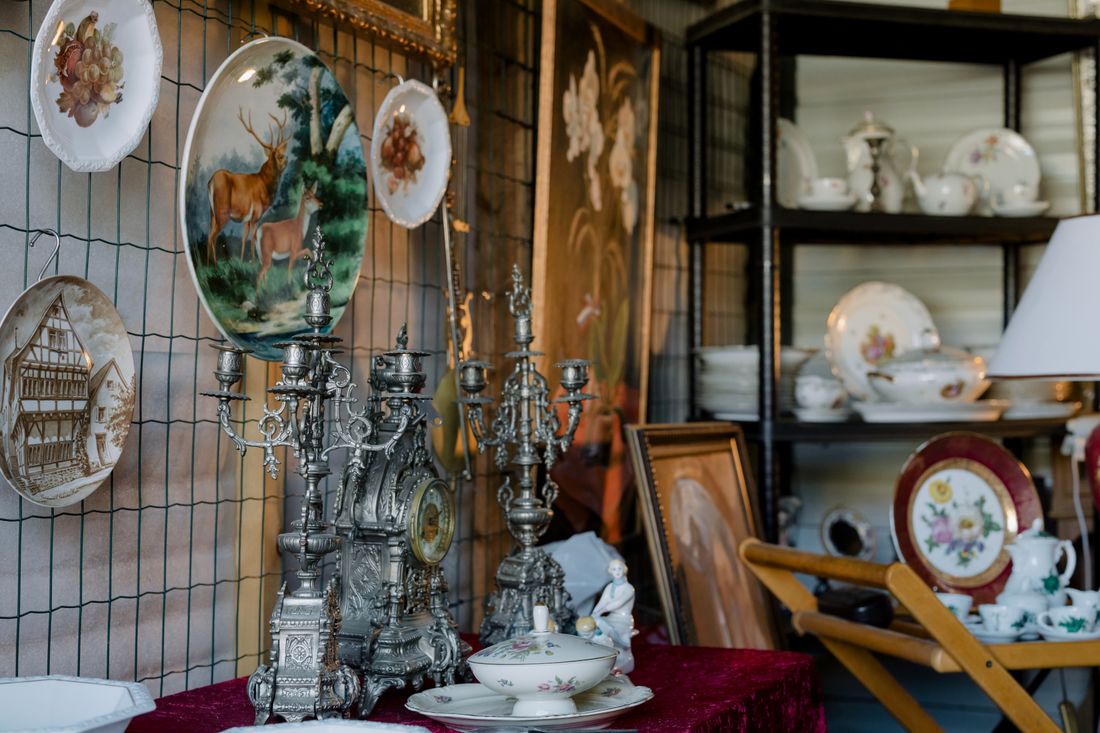
The mark on the bottom of a plate is the least trustworthy thing about it. Crossed swords, a French place name or a royal-sounding crest can each be copied by a factory three generations later, and a good many were. Before we talk price on porcelain, china or art glass, we read the whole object: the paste, the glaze, the foot rim, the weight, the decoration, the repairs. Here is how that works in practice, so you know what we look at when we visit a home in Delray Beach.
What we look for
- Meissen, Limoges, Royal Doulton, and marked makers
- Chinese and Japanese porcelain
- Lalique, Baccarat, and cameo / art glass
- Dinner services and figural pieces
How we identify and date porcelain, china and glass — marks, paste, glaze and reproduction traps
Marks help, but only when they agree with everything else on the piece. Collectors’ reference guides keep warning about the same two failures: marks that were copied, and marks that were read too literally. Some examples we meet constantly:
- Meissen’s crossed swords. The mark dates from about 1725, and the factory in Germany still uses it, so the mark alone cannot date a piece. It is also among the most imitated marks in ceramics. On the genuine mark the sword handles sit at the bottom with the blades pointing up, and copyists are not always careful about that. Dresden-style decoration and the initials “KPM” cause the same confusion, because several German firms used lookalike marks.
- “Limoges.” Porcelain has been made in Limoges, France, since the mid-nineteenth century, and the word in a mark does not tell you the age. An American firm in Sebring, Ohio, also sold “Limoges” china in the early 1900s and later renamed itself the American Limoges China Company after the French company threatened to sue. Many French pieces carry the name of a decorating studio or importer rather than the maker. A well-known torch-style mark is sometimes simply a studio stamp, and in some cases it was applied over the original maker’s mark.
- Royal Doulton and Sèvres. The “Royal Doulton” name only appears in the early 1900s, so a Victorian date claim with that mark is wrong. Sèvres is the most forged name in French porcelain: genuine pieces carry interlaced Ls with a date letter, and a great deal of nineteenth-century “Sèvres” was decorated and marked to imitate the original.
So we check the body. Hard-paste porcelain (kaolin and feldspathic stone, fired very hot) is dense, glassy and translucent when held to a light, and the glaze fuses to it; Meissen made the first European hard-paste around 1710. Soft-paste porcelain, an earlier and lower-fired recipe that includes glassy frit, looks creamier, and its glaze seems to sink into the body. Sèvres itself switched from soft-paste to hard-paste around 1770, which is a useful dating line. We look at an unglazed foot rim or a chip, at how the glaze sits, and at whether the gilding wears like the real thing.
For glass, the questions change: pontil scars versus ground bases, mould seams, the ring of lead crystal, wheel-cut versus pressed pattern. Signed art glass has its own rules. René Lalique’s pieces were marked “R. Lalique” before 1945 and plain “Lalique” afterwards, Baccarat used an acid-etched mark, and cameo glass is judged by the depth and finish of the carving. As Kovels puts it, check colour, texture, weight, design and feel alongside the mark — which is exactly the order in which we work.
The science most buyers (and most dealers) never mention
When a piece is valuable enough and the doubt is real, there is a laboratory method that does not care what the base says: thermoluminescence (TL) dating. Clay contains tiny crystals, quartz and feldspar above all, and those crystals have defects that act as traps. Natural radiation from uranium, thorium and potassium-40 in the clay and the soil keeps filling those traps with electrons. When the object is fired in the kiln, the traps are emptied and the clock goes to zero. From then on the traps slowly refill. In the lab, a small sample is heated and the trapped electrons are released as a faint glow of light. Divide the radiation dose recorded by the yearly dose rate, and you get the time since the last firing.
This is a measurement of physics, not of style, which is why it is the courts’ favourite answer to “is it old or is it new?”. What do the open scientific papers add?
- The traps are real defects in the crystal. A 2025 arXiv study on quartz (arXiv:2504.18077) used density-functional modelling to show how oxygen deficiency and impurities such as iron and aluminium create electron and hole traps, and why some defects emit light and others kill it. The authors say the theory behind these traps is still not settled, which is why labs calibrate so carefully against known samples.
- The dose rate is measured, not guessed. A paper from a luminescence-dating group (arXiv:1811.03664) describes counting alpha and beta particles from four decay pairs, which gives the activity of the uranium-238, uranium-235, thorium-232 and potassium-40 sources. Handling the correlated uncertainties properly improved dose-rate precision by about a factor of two in their example.
- It is not a casual test. The patent literature notes that classical TL sampling takes a clay plug roughly 3 mm across, which can damage thin porcelain. A 2026 arXiv paper on AI porcelain classification (arXiv:2601.14791) lists cost and potential damage as the reason such methods are rarely used. Its sister paper (arXiv:2603.28474) trained on 29,596 specimens to judge dynasty, kiln and glaze, but its authors concede that true authentication is a harder, unsolved task. A non-destructive alternative, Raman spectroscopy, can sort ancient porcelain and glaze by composition and firing temperature (arXiv:cond-mat/0701351), but it does not give a date.
What it means for you: TL answers the question “when was this body last fired?” with a result usually quoted with an uncertainty of roughly 10 to 20 percent of the age. That is enough to separate an eighteenth-century piece from a 1960s copy, but not to pick a year. It cannot say when the decoration was added, and a determined forger can try to fake the radiation history. We do not send every cup to a lab. We use the method as a mindset, and we will tell you honestly when a piece is important enough that a TL test (or a specialist auction house) is worth the fee before you sell.
What actually drives the value
- Maker and model. A confirmed Meissen figure, a Sèvres vase or a signed Lalique piece lives in a different market from unmarked or decorator-studio ware. A named form or pattern matters as much as the factory.
- Hand-painted versus transfer-printed. Brushwork, gilding that stands up from the glaze and individual artist signatures carry the premium. Transfer decoration is worth far less.
- Condition and repair. Chips, hairlines and restoration can cut value sharply. Ultraviolet light shows old repairs and overpainting that the eye misses, so we check every piece.
- Completeness. Lids, stands, liners and full sets count. A complete service for twelve is easier to place than odd pieces, but sets sell for less than most people expect, since dinnerware is plentiful.
- Age and rarity. Eighteenth- and early-nineteenth-century wares, early studio glass and limited forms are scarce. Most of what comes through the door is late Victorian to mid-century, and we buy that fairly, for what it is.
- Provenance. Old labels, inventories and family history strengthen a marked piece, and with a doubtful one they can be the deciding evidence.
Whatever the verdict, you hear it straight. If a set is worth more to your family than on the market, we will say that too.
Not sure if your piece fits? Text a photo to (561) 465-3536 — we will tell you honestly and for free, with no obligation to sell.
Questions
Selling porcelain, china & glass in Delray Beach
Does a Meissen or Limoges mark mean my piece is valuable?
Not on its own. The crossed swords of Meissen have been used since about 1725 and are widely copied, and the word “Limoges” in a mark does not prove age or quality. We look at the paste, glaze, foot rim, decoration and condition together with the mark. Send us clear photos of the front, the base and the mark, and we will tell you what it really is.
What is the difference between hard-paste and soft-paste porcelain?
Hard-paste is made from kaolin and feldspathic stone fired at very high heat, giving a dense, translucent body with a fused glaze. Soft-paste is an older recipe that includes glassy frit and is fired lower, so it looks creamier and the glaze seems to sink into the body. The difference helps date European pieces. For example, Sèvres moved from soft-paste to hard-paste around 1770.
Can porcelain be scientifically dated, and is it worth doing?
Yes. Thermoluminescence dating measures the radiation a fired clay body has stored since it was last fired, so it separates old from new regardless of what the mark says. It needs a small sample, costs real money, and gives an age within roughly 10 to 20 percent, not an exact year. It makes sense for a high-value piece with a real doubt. For ordinary china it is not worth the fee, and we will tell you which case yours is.
Do chips, cracks or repairs ruin the value?
They reduce it, sometimes sharply, but they do not make a piece worthless. A rare form or an important maker still sells with damage. Please do not glue or repaint it yourself, since that makes expert restoration harder. We check pieces under ultraviolet light, where old repairs show up clearly, and give an offer based on the real condition.
Will you come to my home to look at china and glass in Delray Beach?
Yes. We visit homes across Delray Beach and Palm Beach County, examine each piece with its mark and base in hand, and pay on the spot for what we buy. We handle and pack fragile porcelain and glass ourselves. For a single piece, a few photos by text are enough to start.
We also buy