Lot VI
Clocks & Pocket Watches
in Delray Beach
Tall-case, carriage, and marine timepieces.
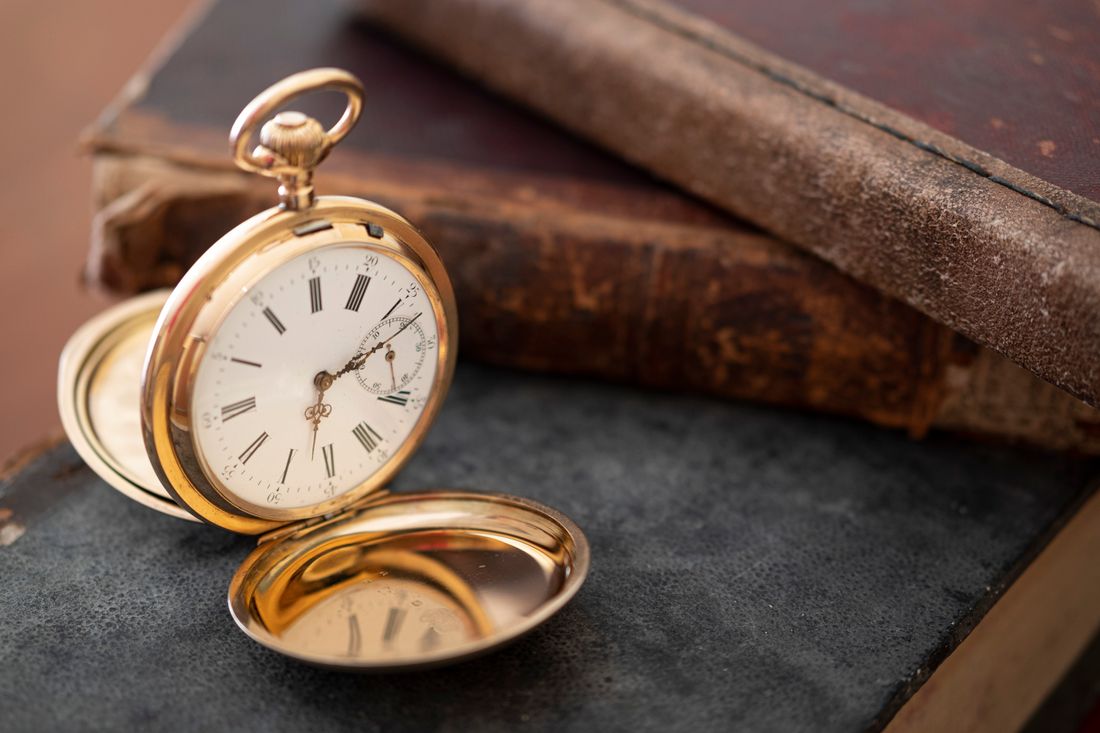
A clock or a pocket watch tells you a great deal before it ever ticks. We open the case, read the dial, find the serial number, and look at who actually made the movement and who only sold it. This is the working knowledge we bring into a Delray Beach home, so you can see what we are looking at and why a quote is what it is.
What we look for
- Tall-case (grandfather) and bracket clocks
- French carriage and mantel clocks
- Railroad-grade and complicated pocket watches
- Running or not — condition is factored, not disqualifying
How we identify and date clocks and pocket watches
First we sort the piece into its family, because each family is valued on different evidence:
- Tall-case (grandfather) clocks. Floor clocks built around a long pendulum. They were a staple of American homes from about 1680 to 1840, and many of the “grandfathers” people inherit are 20th-century cases built around newer movements, which is a very different market.
- Shelf and mantel clocks. Eli Terry patented a smaller, cheaper movement in 1816, which let the clock leave the floor and sit on a shelf. American factories turned these out by the thousands, and condition and originality separate the good ones from the common ones.
- Bracket and carriage clocks. English bracket clocks and French brass carriage clocks are spring-driven and portable. Signed movements and complete cases matter a great deal here.
- Pocket watches. Everything from plain silver “dollar” types to gold-cased American railroad watches and fine European pieces.
The name on the dial is not always the maker. It can be the retailer or a merchant who sold the clock, so we check the dial, the back plate, and any paper label inside the case before we credit anyone. A foreign label on the works does not make a clock old either; many clocks sold here in the early 1900s carried European movements.
Railroad-grade watches. After a railway collision in 1891, Webb C. Ball was hired to set time-inspection standards for the Lake Shore & Michigan Southern line, and his rules spread across much of the industry. The mature specification was demanding: a 16 or 18 size open-face movement, at least 17 jewels from the mid-1890s, adjustment to five positions plus temperature and isochronism, a double-roller escapement, and a variation of no more than about 30 seconds a week. From roughly 1908 the strict lines also wanted a lever-set movement and Arabic numerals, with older pendant-set watches grandfathered in. A Hamilton, Elgin or Waltham that really meets those marks is a different animal from a pretty watch with “17 jewels” printed on the dial.
Dating by serial number. The big American makers, Waltham, Elgin and Hamilton, numbered their movements, and each company’s published tables convert a serial into a production year. The number is stamped on the movement, so the case has to come off. Numbers are only comparable within one maker. Elgin, founded in 1864, ran well into the millions, so a number that looks “low” for one brand can be late for another. We read the serial together with the grade name, size and jewel count, because a movement can also have been re-cased or re-dialed after it left the factory.
One small detail collectors love: before World War I, a printed or hand-cut watch paper was often tucked inside the case back by the watchmaker who serviced it. Please leave it where it is.
The science most buyers (and most dealers) never mention
Every mechanical clock is a controlled argument with friction, and the escapement is the referee. A peer-reviewed physics paper on a grasshopper-escapement pendulum clock (arXiv:2111.07302, published in Physical Review E) puts numbers on why some clocks keep time and others wander.
The escapement is what makes the clock a clock. A free pendulum would just swing down and stop. The escapement hands it a small push at a fixed point in each swing, which turns it into a self-sustaining oscillator. Because the push comes from the pendulum’s own position, the beat is set by the pendulum and not by whatever is driving it.
The sweet spot in the swing. The paper shows that the period of such a clock has a local minimum as the swing size changes. At that point, small changes in swing size, and so small changes in the pull of the weight or spring, barely change the rate. A lossier pendulum (lower quality factor) with a fairly large swing sits nearer that flat spot and recovers from disturbances faster. In other words, a little friction can improve timekeeping, which is the opposite of what most people assume.
Accuracy has a physical cost. The author finds that a clock’s precision scales linearly with its rate of entropy production. Put simply, to tell time well, a clock has to dissipate energy. The test clock was a modest 0.3 kg pendulum with a 1.8-second period driven by about 110 microwatts. Its measured period scatter was only about 0.009 seconds, around half a percent, and the author’s noise model matched the measured scatter closely.
Why this matters in your living room. It explains what we see every week. A clock that is out of beat, dirty or running on dried oil has lost swing, and with it that stable flat spot. It also explains why railroad inspectors cared about position: patent and engineering literature on watch oscillators defines isochronism as the change in rate with swing size and with the watch’s position. A pocket watch’s balance and hairspring are limited by pivot friction to a quality factor of roughly 300 (EPFL research), and gravity pulls differently on the balance when the watch lies flat or stands upright. Adjusting a watch to five positions was the craftsman’s way of tuning that error out. Today’s silicon hairsprings and flexure oscillators are attempts to push those same limits further, which is why a well-adjusted antique movement is genuinely impressive for its time.
What actually drives the value
- Maker and grade. For watches, the difference between a base-grade and a top-grade movement from the same factory can be many times in price. For clocks, a signed English or American maker beats an unsigned or retail-labeled piece.
- Meeting the railroad specification. A genuine 21-jewel, adjusted, lever-set railroad watch in good order is a recognized collector category. A fashion watch that borrows the vocabulary is not.
- Originality. Original dial, hands, case and movement together carry the premium. A re-dialed watch, a replaced pendulum or a “married” movement and case all cost value.
- Case metal. A 14K or 18K gold case has real material value on its own, which is why we always check the marks. Gold-filled and plated cases do not.
- Complete and honest condition. Missing weights, keys, glass, cracked dials and heavy repairs matter. A clean, original dial matters more than a freshly polished case.
- Rarity versus volume. Early tall-case clocks and fine carriage clocks are scarce. Mass-produced late-20th-century grandfather clocks are common and usually bring modest sums, and we say so plainly.
Whatever the verdict, you hear it straight. If a clock is worth more to your family than to the market, we will tell you that too.
Not sure if your piece fits? Text a photo to (561) 465-3536 — we will tell you honestly and for free, with no obligation to sell.
Questions
Selling clocks & pocket watches in Delray Beach
Do you buy clocks and watches that no longer run?
Yes. Many of the best pieces we see have been silent in a drawer or hallway for decades. A stopped movement is often a matter of dried oil or a broken mainspring, and the value depends far more on maker, originality and case metal than on whether it ticks today. Please do not oil it or force the hands before we see it.
How can I tell if my pocket watch is a railroad-grade watch?
Look for a lever-set movement (you pull out a small lever under the crystal rim to set the time), an open-face design, a plain dial with bold Arabic numerals, and a stated jewel count of 17 or more, often with “adjusted” and the grade name engraved on the movement. Famous grades from Hamilton, Elgin, Waltham and others are also catalogued by serial number. Send us a photo of the dial and the movement and we will confirm.
How do you date a watch from its serial number?
We note the maker, grade and serial number on the movement and check them against that maker’s published production tables, then confirm the date against the style of the dial, case and balance. Serial numbers only compare within one company, and a watch can be re-cased later, so we always read the number alongside the rest of the evidence.
Will you come to the house for a grandfather clock or a whole collection?
Yes. We visit homes anywhere in Delray Beach and Palm Beach County to look at tall-case clocks, wall clocks and collections that are not easy to move. We appraise on the spot, never ask you to dismantle a clock, and pay the same day for what we buy. For a single watch, a photo by text is enough to start.
Is it worth getting a clock or watch repaired before selling it?
Usually not. A repair can cost more than it adds, and a poor repair or replaced parts can lower the value. We price clocks and watches as they are, and we will tell you plainly if a piece is worth restoring or better sold as it stands.
We also buy